
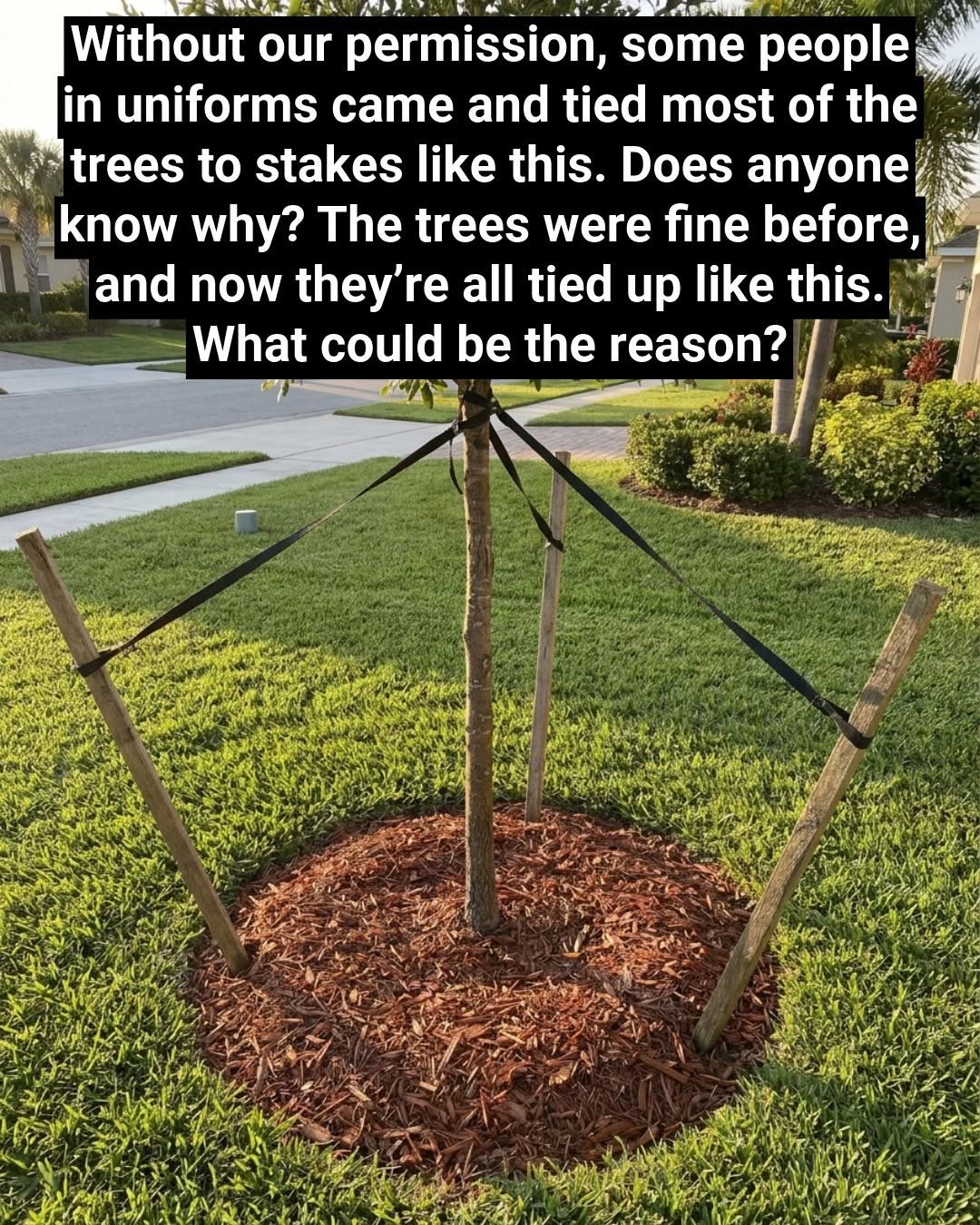
When a tree sways in the wind, the movement triggers the tree to produce growth hormones that cause the trunk to grow thicker and stronger at the base. This natural tapering is what allows a massive oak or pine to withstand hurricane-force winds decades later.
Staking Method
Effect on the Tree
Staked too tightly / too high
The trunk doesn’t sway. It grows straight up but remains thin, weak, and prone to snapping once the stakes are removed.
Staked loosely / at the base
The lower trunk is anchored, but the top third of the tree is free to sway in the wind. The trunk thickens naturally.
💡 Key insight: The goal of staking isn’t to immobilize the tree. The goal is to protect the roots while allowing the trunk to build its own strength.
📋 The Checklist: Does Your Tree Actually Need Stakes?
In my experience, the greatest challenge to properly supporting young trees comes from assuming that all newly planted trees need staking.
Not every tree needs to be staked.
Before you drive stakes into the ground, evaluate your tree.
Stake the Tree IF:
✅ It is a bare-root tree (no soil around the roots).
✅ The root ball is very small compared to the size of the canopy (top-heavy).
✅ It was planted in an extremely windy location or an open field.
✅ The soil is very loose, sandy, or poorly drained.
✅ The trunk is so thin it bends over completely on its own.
✅ There is heavy foot or vehicle traffic that might bump into it.
DO NOT Stake the Tree IF:
❌ The trunk is already thick and stiff (usually over 1-2 inches in caliper).
❌ The tree is planted in a sheltered area, like a fenced backyard or among other trees.
❌ The root ball is large and heavy, providing immediate stability.
❌ The tree species is naturally stiff and upright (like many conifers).
🌿 Pro tip: If you aren’t sure, wait. You can always add stakes a few weeks later if the tree starts leaning. But if you stake it unnecessarily on day one, you risk stunting its growth.
🛠️ How to Stake a Tree Properly (If You Must)
If you determine your tree does need support, doing it correctly is crucial. Improper staking can cause more damage than no staking at all.
The 3 Rules of Proper Staking:
Rule
How to Do It
Why It Matters
1. Stake Low
Attach the ties to the lower third of the trunk (just above the point where it naturally bends).
Allows the top two-thirds of the tree to sway in the wind, triggering trunk thickening.
2. Use Flexible Ties
Use wide, soft materials like canvas straps, rubber tree ties, or even cut-up pieces of old t-shirts.
Narrow materials like wire or thin rope will cut into the bark and girdle (strangle) the tree.
3. Allow Movement
Leave enough slack in the ties so the tree can move 2–3 inches in any direction.
Prevents the trunk from growing dependent on the stakes and encourages root establishment.
Step-by-Step Installation:
Drive the stakes: Use wooden or metal stakes. Drive them into the ground outside the root ball (about 12–18 inches away from the trunk) so you don’t pierce the roots.
Attach the ties: Loop the flexible tie around the stake, across to the trunk, and back to the stake.
Check the slack: Push gently on the trunk. The base should hold firm, but the top should sway freely.
Form a figure-eight: If using rope, cross it between the stake and the tree to prevent the bark from rubbing against the stake.
⏳ When to Remove the Stakes
This is where many homeowners make their biggest mistake. They install the stakes and simply forget about them.
The Timeline for Removal:
Standard Rule: Remove stakes after 6 months to 1 year.
The “Push Test”: After a year, gently push on the trunk of the tree. If the root ball moves or lifts out of the soil, it needs more time. If the trunk bends but the base stays firmly anchored in the ground, the roots are established, and the stakes can come out.
Never leave stakes for more than 2 years: Beyond this point, the stakes will begin to restrict the trunk’s growth, and the ties will cut into the bark.
⚠️ Warning: If you leave narrow ties on a growing tree, the bark will grow over them. This cuts off the flow of nutrients between the leaves and the roots, a fatal condition called girdling. Always check your ties every spring!
❓ Frequently Asked Questions
Q: Can I use wire to stake my tree?
A: Never use bare wire directly against the bark. If you must use wire for structural support, always sleeve it in a piece of rubber hose or heavy canvas to protect the tree.
Q: My tree is leaning. Should I pull it straight and stake it?
A: Young trees have an amazing ability to correct their own growth toward the sun (phototropism). If the lean is slight, let it correct itself. If it’s severe (more than 15-20 degrees), you can gently pull it upright and stake it loosely, but do not force it perfectly vertical if it risks breaking the roots.
Q: How deep should the stakes go into the ground?
A: Drive them at least 12 to 18 inches into the soil, or deep enough that they feel completely solid and don’t wiggle when you push them.
Q: What if I forgot to remove the stakes and the ties are stuck in the bark?
A: Carefully cut the ties away with sharp scissors or pruning shears. Do not try to pull them out if the bark has grown over them. If the tree is severely girdled, consult a certified arborist, as the tree may need specialized care to survive.
Q: Should I wrap the trunk of the tree for the winter?
A: Generally, no. Tree wraps can trap moisture and harbor pests. Young trees benefit from experiencing the natural temperature changes of the seasons, which helps them harden off for winter.
💙 A Compassionate Closing Thought
If you are reading this because you just brought home a tiny sapling from the nursery, or because you’re looking out your window at a young tree in your yard, please know:
🌱 Growth requires movement. Just like a tree needs the wind to build a strong trunk, we need the gentle (and sometimes not-so-gentle) challenges of life to build our own resilience.
🌱 Support is temporary. The best kind of help we can give—whether to a tree, a child, or a friend—is just enough support to keep them safe while they find their own strength.
🌱 Patience is a gardener’s greatest tool. A tree doesn’t grow overnight. It takes time for roots to reach deep into the dark soil. Trust the process, even when you can’t see what’s happening underground.
🌱 Letting go is part of love. Eventually, the stakes must come off. Watching something stand tall on its own is one of the greatest joys of nurturing it.
That little tree in your yard isn’t just a plant.
It’s a living testament to the fact that with the right foundation, a little bit of support, and the freedom to sway in the wind, even the smallest sapling can weather any storm.
So plant it well. Stake it only if you must. And then, step back, and watch it grow.
Do you have young trees in your yard? Have you ever noticed how they bend in the wind and stand back up again? Share your gardening experiences and tree stories respectfully in the comments below.
