
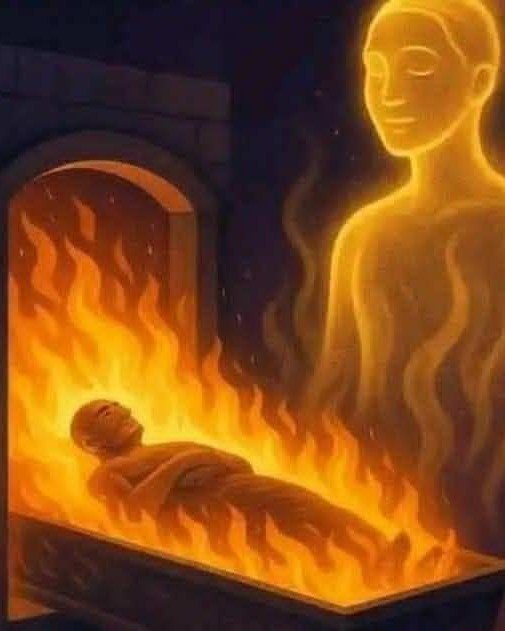
The truth about cremation, What really happens — and what it does for the soul.
What happens to the soul?
This is where things become deeply personal, and beliefs influence everything.
Various religions and spiritual traditions interpret the journey after death in diverse ways.
A journey to the afterlife
In Hinduism, cremation is the norm. The soul, which is thought to be eternal, departs from the body and progresses towards the next existence. Fire is considered sacred, aiding the soul in detaching and continuing its path.
Thus, cremation is not merely a method of disposing of the body; it is a spiritual ceremony that facilitates the soul’s transition to the next phase of its journey.
Buddhism also frequently embraces cremation, but the emphasis is not on a permanent soul. Instead, it revolves around the ongoing consciousness through cycles of rebirth. Cremation acts as both a ritual and a recognition of life’s transience, honoring the natural cycle while supporting the continuous journey of consciousness.
Belief over the body
In the past, Christians favored burial due to their beliefs in resurrection. Nowadays, most denominations accept cremation, provided it does not undermine the hope of resurrection.
Christians hold that after death, the soul is judged by God and ascends to heaven, descends to hell, or enters a waiting state like purgatory. The treatment of the body—whether through burial or cremation—does not influence the soul’s destiny; rather, it is faith and one’s connection with God that shape the soul’s journey.
Honor and Respect
In Islam, cremation is strictly forbidden. Burial is prompt and straightforward, reflecting the respect owed to the body. Muslims believe that the soul remains linked to the body until the Day of Judgment, making it a spiritual obligation to honor the body.
Secular or spiritual viewpoints
Not everyone adheres to organized religion. Many individuals perceive cremation as a natural way to return to the earth. Some envision the soul transitioning to another realm, merging with the universe, or continuing to exist through memories.
Conversely, others, such as humanists or scientists, regard consciousness as ceasing at death, viewing cremation as a practical or ecological option rather than a spiritual one.
The Bottom Line
Cremation doesn’t have to be intimidating. With straightforward procedures, respect for the deceased, and an understanding of the associated rituals and beliefs, it serves as just another method to celebrate life. Whether you are spiritual, religious, or simply practical, there is space for tranquility in the process — and in what follows.
What are your thoughts on what happens to the soul when someone passes away and is cremated? We invite you to share your opinions in the comments.
