
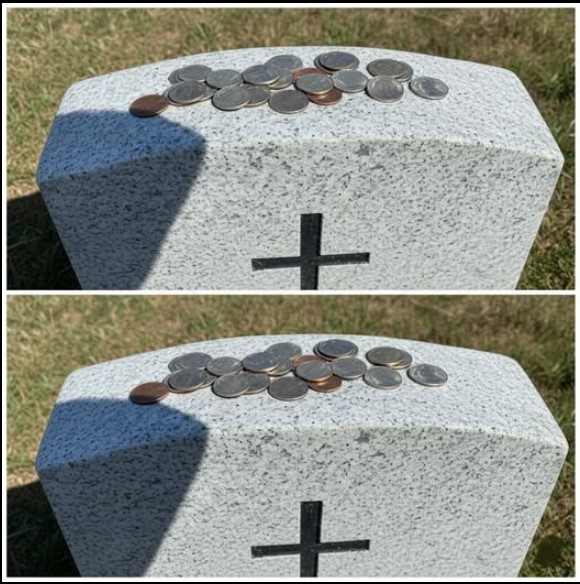
For grieving families—especially those of fallen soldiers—these coins are more than tokens. They’re proof that their loved one’s sacrifice is seen, honored, and remembered by others.
Many cemetery groundskeepers collect the coins and use the funds for:
Grave maintenance
Flags for veterans’ graves
Upkeep of memorial sites
So your penny doesn’t just say “I remember”—it helps preserve that memory for others.
🌍 Beyond the Military: A Universal Gesture
While the coin code is most formalized in military contexts, the spirit of the gesture extends to all graves:
A penny on a civilian’s grave? It still means: “I saw you. I honored your name.”
In Jewish tradition, visitors sometimes place small stones—not coins—but the meaning is similar: “I was here.”
It’s a human impulse: to leave a trace of our presence when words fall short.
🕯️ How to Honor This Tradition
If you feel moved to leave a coin:
✅ Use clean, unblemished coins
✅ Place it gently on the headstone or at the base
✅ Do it in silence or with a quiet thought
✅ Never remove coins left by others—they’re sacred messages
And if you see one?
👉 Pause. Read the name. Say it aloud.
You’ve just become part of the chain of remembrance.
💛 Final Thought
In a world of noise and haste, the coin on a grave is a whisper of humanity.
It costs almost nothing—but says everything:
“Your life mattered.
Someone came.
Someone stayed.
Someone remembered.”
So the next time you see that glint of copper in the grass, don’t look away.
Look closer.
And honor the quiet story it tells.
