
Before Indoor Plumbing:
Era
Bathroom Setup
Pre-1800s
Homes had a “bathroom” for bathing, but no running water. Water was carried from wells or pumps, heated manually, and poured into a tub.
Toilet facilities
Often separate outhouses or chamber pots kept in bedrooms or hallways.
Privacy
Limited; bathing and toilet use were often communal or semi-private affairs.
The Arrival of Indoor Plumbing:
When indoor plumbing finally became common in the mid-to-late 1800s, homes already had a room called the “bathroom”—but that space was designed for bathing, not for the new flush toilet.
So where should the toilet go?
The simplest solution: install it in a small, private room—essentially a closet—with a water supply for flushing.
Thus, the Water Closet was born.
Discover more
Home Storage & Shelving
Toilet
Waste Management
Why the Term Stuck:
✅ Clarity: “Water Closet” clearly distinguished the toilet room from the bathing room
✅ Privacy: Emphasized the enclosed, personal nature of the space
✅ Hygiene: Highlighted the presence of running water—a major advancement in sanitation
✅ International adoption: The term traveled well across languages and cultures
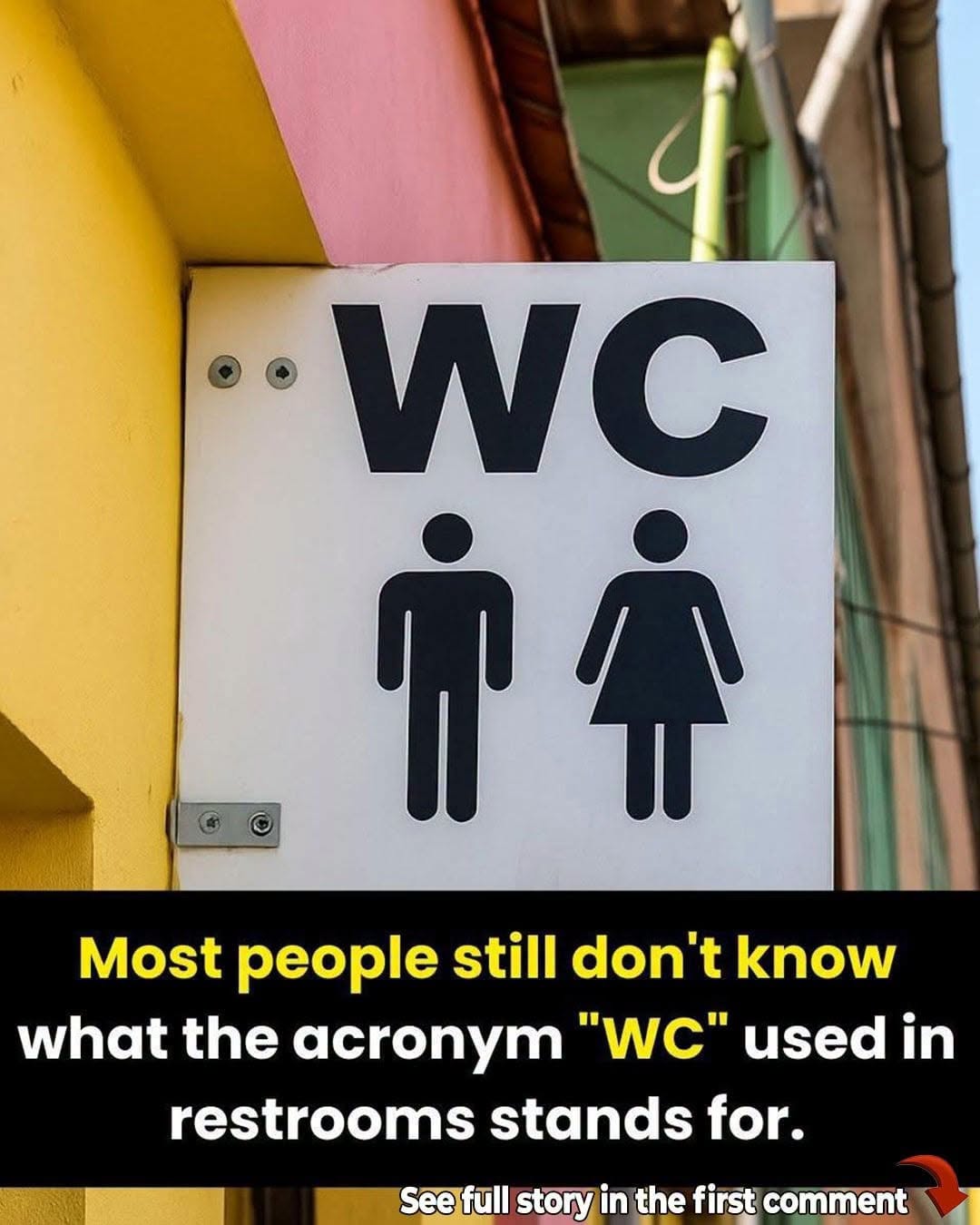
📜 Historical note: The abbreviation “WC” has been in use on signage since the 1870s, making it one of the oldest standardized symbols for public restrooms.
🌍 Why WC Is Still Used Today (Especially in Europe)
If WC is so old-fashioned, why do we still see it on signs in 2024?
Reasons for Its Endurance:
Reason
Explanation
International standardization
WC is widely understood across language barriers; no translation needed
Space efficiency
Two letters take up less room on signs than “Restroom,” “Toilet,” or “Bathroom”
Historical continuity
Many European buildings, especially older ones, retain original signage
Cultural preference
In some regions, “WC” is simply the expected term; alternatives may sound foreign or informal
Tourism and travel
International travelers learn to recognize WC as a universal symbol
Where You’ll Still See WC:
✅ Europe: UK, France, Germany, Italy, Spain, and most EU countries
✅ International airports: Standardized signage for global travelers
✅ Hotels and tourist sites: Especially in historic or heritage buildings
✅ Public transportation: Train stations, bus terminals, and ferry terminals
✅ Older buildings: Any structure built before the mid-20th century may retain original WC signage
🗺️ Travel tip: If you see “WC” on a sign abroad, you’ve found the restroom. No need to ask—just follow the arrow.
📱 Social Media Reacts to the WC Revelation
When @itsnathannyc posted his TikTok explaining the meaning of WC, the response was immediate—and often hilarious.
Common Reactions:
Comment Type
Example
Mind-blown
“I’m 34 and just now learning this. My whole life has been a lie.”
Gratitude
“Thank you! I’ve been seeing WC on signs in Paris for years and never asked.”
Humor
“So all this time I’ve been looking for the ‘Water Closet’ and it was just… a toilet?”
Nostalgia
“My grandma used to say ‘WC’ and I thought it was just her being fancy.”
Curiosity
“What other everyday terms have hidden histories??”
Why the Video Went Viral:
✅ Relatable mystery: Many people have wondered about WC but never looked it up
✅ Simple, satisfying answer: The explanation is short, clear, and easy to remember
✅ Educational + entertaining: History lesson delivered with humor and personality
✅ Shareable format: Short video, bold text, and a “wait, really?” hook
🎥 Social media insight: Content that answers a common but unasked question often performs well because it makes viewers feel “in the know”—and eager to share that knowledge.
Discover more
Plumbing Fixtures & Equipment
Toilets
toilet
🧠 Other Confusing Restroom Signs Around the World
WC isn’t the only restroom abbreviation that puzzles travelers. Here are a few more you might encounter.
International Restroom Terminology:
Abbreviation/Term
Meaning
Where You’ll See It
Ladies / Gents
Women’s / Men’s restroom
UK, Ireland, Commonwealth countries
**Toilettes **(FR)
Toilets (French/Spanish)
France, Spain, Latin America
**Toiletten **(DE)
Toilets (German)
Germany, Austria, Switzerland
**Servizi Igienici **(IT)
Hygienic services (Italian)
Italy
**Aseos **(ES)
Toilets (Spanish)
Spain, Latin America
WC Dames / WC Heren
Women’s / Men’s WC (Dutch)
Netherlands, Belgium
🚻 Symbol
Universal gender-neutral restroom icon
International airports, modern buildings
Pro Tips for Travelers:
✅ Look for symbols: The stick-figure icons (🚹🚺) are universally recognized
✅ When in doubt, ask: A simple “Where is the toilet?” in the local language goes a long way
✅ Download offline maps: Apps like Google Maps often label restrooms, even without data
✅ Carry tissues: In some countries, public restrooms may not provide toilet paper
🌐 Cultural note: In some regions, restrooms may be gender-neutral, pay-to-use, or located outside the main building. A little research before traveling can prevent surprises.
🚽 Fun Facts About Restroom History
The story of WC is just one chapter in the fascinating history of human sanitation.
Quick Restroom Trivia:
Fact
Why It’s Interesting
First flush toilet
Invented by Sir John Harington in 1596 for Queen Elizabeth I (but didn’t catch on widely)
Thomas Crapper
Often (wrongly) credited with inventing the toilet; he was a prominent plumber who popularized flush systems in the 1800s
Public restrooms in ancient Rome
Featured long benches with holes and a flowing water channel for sanitation—basically communal WC rows
First public pay toilet
Introduced in London in 1851; cost 1 penny (hence the phrase “spend a penny”)
Gender-neutral restrooms
Becoming more common globally, reflecting evolving understandings of gender identity
🧼 Hygiene note: The evolution of restrooms reflects broader advances in public health, engineering, and social norms. Every flush is a small victory for sanitation.
❓ Frequently Asked Questions
Q: Is WC the same as a bathroom?
A: Not exactly. A “bathroom” typically includes a bath or shower. A “WC” or “Water Closet” refers specifically to a room with a toilet. In many homes, these are separate spaces.
Q: Why don’t we use “WC” more in the United States?
A: American English favors “restroom,” “bathroom,” or “men’s/ladies’ room.” “WC” is understood but rarely used in everyday speech, likely due to cultural preferences and marketing.
Q: Is “Water Closet” considered old-fashioned?
A: In some regions, yes. In others, it’s standard terminology. The abbreviation “WC” remains widely used on signage regardless of spoken preferences.
Q: Are there other abbreviations for restrooms?
A: Yes. You might see “RR” (Rest Room), “PT” (Public Toilet), or simply the universal 🚻 symbol. Context and location matter.
Q: Why do some restrooms have both “WC” and “Toilet” on the sign?
A: Redundancy aids comprehension, especially for international travelers who may recognize one term but not the other.
Q: Is it rude to ask what “WC” means?
A: Not at all! Most people appreciate curiosity. Asking shows engagement with the culture and a desire to learn.
Q: Do all European countries use “WC”?
A: Most do, but local terms vary. In France, you’ll see “Toilettes”; in Germany, “Toiletten”; in Italy, “Servizi.” “WC” is often included as a universal backup.
Q: Can I use “WC” in conversation?
A: You can, but be aware of your audience. In the U.S., it may sound formal or foreign. In Europe, it’s perfectly normal.
Q: What about accessible restrooms?
A: These are often labeled with the International Symbol of Access (♿) alongside “WC,” “Toilet,” or local terminology.
Q: Why do some restrooms have a coin slot?
A: In some countries, public restrooms charge a small fee for maintenance. Keep a few coins handy when traveling in Europe.
💙 A Compassionate Closing Thought
If you’re reading this because you just learned what WC stands for—or because you’ve been quietly wondering for years—please know:
🚽 Curiosity is a gift. Asking “What does that mean?” is how we learn, connect, and grow. Never feel silly for wondering.
🚽 Language is layered. Words carry history, culture, and context. Understanding them deepens our appreciation of the world.
🚽 Travel is education. Every sign, symbol, and phrase you encounter is a chance to learn something new about how others live.
🚽 You’re not alone. Millions of people have stared at a “WC” sign and wondered. Now you know—and you can share that knowledge with others.
That little two-letter sign isn’t just a direction to a restroom.
It’s a tiny time capsule.
A reminder of how far we’ve come in sanitation, design, and global communication.
And proof that sometimes, the most ordinary things have the most interesting stories.
So the next time you see “WC” on a door—whether in a Paris café, a Berlin train station, or a small-town pub—smile.
You’re not just looking for a restroom.
You’re connecting with history.
And that’s worth a flush.
Did you know what WC stood for before reading this? What other everyday terms have you wondered about? Share your “aha!” moments and travel stories respectfully in the comments below.
