
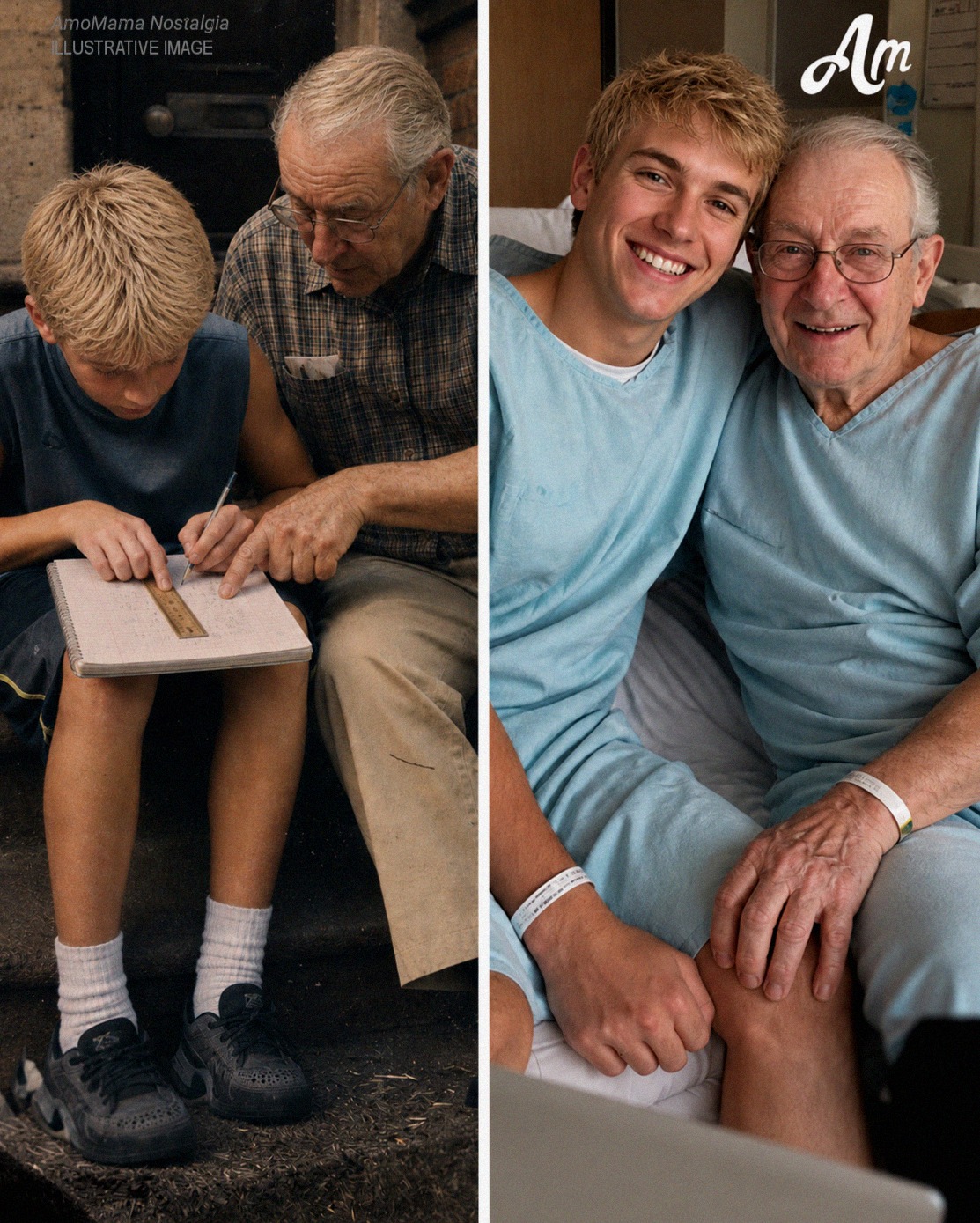
Mason never thought his quiet evenings helping a struggling boy with math would matter much. But 11 years later, when he found himself alone in a hospital room with little hope left, a familiar voice from the past returned with a reminder he never expected.
Advertisement
For years, Mason sat on the same cracked wooden bench near the edge of a rundown neighborhood where people learned to keep their heads low and their doors locked.
The bench stood beside a narrow patch of dirt between an old grocery store and a bus stop with a broken glass panel. In winter, the wind cut through his coat. In summer, dust clung to his shoes. But Mason came anyway.
He had nowhere important to be.
Every evening, he carried a worn notebook under one arm and a dull pencil tucked behind his ear. The notebook had a faded blue cover, bent corners, and pages filled with numbers, formulas, and careful little diagrams.
Advertisement
To anyone passing by, he probably looked like a lonely old man scribbling nonsense to pass the time.
But to Mason, those numbers were order.
They were calm.
They did not shout, leave, lie, or disappear.
He would sit there quietly, solving math problems while the neighborhood moved around him. Mothers dragged tired children home from school. Men smoked near the corner store. Teenagers kicked pebbles along the curb and laughed too loudly.
Advertisement
Nobody paid much attention to him.
Until one day, a shy boy stopped beside him.
Mason noticed the boy’s shoes first. They were worn thin at the soles and too small at the toes. Then he noticed the schoolbag hanging from one shoulder, patched twice with black tape. The boy could not have been more than ten or eleven.
He stood a few steps away, pretending not to stare.
But his eyes kept dropping to Mason’s notebook.
Mason smiled without lifting his pencil.
Advertisement
“Do you like math?” he asked gently.
The boy hesitated. His fingers tightened around the strap of his bag.
“I’m… trying. But I don’t understand it.”
Mason closed the notebook halfway and studied him for a moment. The boy’s voice was soft, almost swallowed by the street noise. His face carried the tired look of a child who had heard too many adults sigh before helping him.
“What’s your name?” Mason asked.
Advertisement
“Lucas.”
“Well, Lucas,” Mason said, patting the bench beside him, “trying is a good place to start.”
Lucas did not sit right away. He looked down the street as if afraid someone might see him. Then he lowered himself onto the far end of the bench, leaving a wide space between them.
Mason did not rush him.
“What are they teaching you?” he asked.
“Fractions,” Lucas muttered, as if the word itself had insulted him.
Mason chuckled softly.
Advertisement
“Ah. Fractions. They look meaner than they are.”
Lucas glanced at him, doubtful.
Mason leaned forward and used the end of his pencil to draw a circle in the dust near his shoe. He divided it into four uneven parts, then wiped it away and drew another one more carefully.
“Imagine this is a pie,” he said.
Lucas’ eyes narrowed. “What kind?”
“Apple, if you like apple.”
“I like chocolate.”
Advertisement
“Then it is chocolate,” Mason replied, serious as a judge. “Now, if you eat one piece out of four, what do you have?”
“A stomachache if it’s big enough,” Lucas said before he could stop himself.
Mason blinked, then laughed. It had been a long time since anyone had surprised a laugh out of him like that.
From that day on, they met almost every evening.
At first, Lucas came slowly, always glancing over his shoulder, always ready to run if Mason seemed annoyed. But Mason never was. He explained patiently, drawing numbers in the dust, using bottle caps, pebbles, and even leaves to make lessons easier.
When Lucas got something wrong, Mason never snapped.
Advertisement
“Again,” he would say. “Mistakes are just steps with dirty shoes.”
Lucas began to smile more. Not much, but enough for Mason to notice. He started bringing crumpled worksheets from school, the ones marked with red ink and impatient notes. Mason would smooth the pages on his knee and go through each problem as though it mattered.
Because to Lucas, it did.
And because to Mason, Lucas mattered.
Every time the boy solved something correctly, Mason’s whole face softened.
Advertisement
“You’re smarter than you think,” he would say. “Don’t let anyone tell you otherwise.”
Lucas would look away when Mason said that, but the words stayed with him. Mason could tell. They settled somewhere deep, somewhere the boy needed them.
Weeks turned into months. The little space between them on the bench disappeared.
Lucas started sitting close enough to point at the notebook.
Sometimes he asked questions before Mason even finished explaining. Sometimes he corrected himself halfway through a problem, his eyes bright with sudden understanding.
Advertisement
Mason began looking forward to the sound of his footsteps.
Then one day, the boy stopped coming.
At first, Mason told himself Lucas might be sick. Then he wondered if school had become too demanding, or if the boy’s family had moved away without warning. He asked around once, careful not to sound too desperate, but no one seemed to know much.
Or perhaps no one cared enough to say.
Still, Mason returned to the bench.
Advertisement
For a while, he left space beside him.
Then years passed.
Eleven years later, Mason lay in a hospital bed, staring at the ceiling, alone. The room smelled of antiseptic and boiled vegetables. Machines beeped in soft, steady rhythms around him, as if counting down something he did not want named.
His condition was getting worse, and he knew it.
The doctors were kind but careful with their words.
Nurses smiled too gently. Mason had lived long enough to understand what people avoided saying.
Advertisement
That evening, a nurse walked in with another patient.
“He’ll stay here for about an hour,” she said. “We’re moving him to a VIP room soon.”
Mason turned his head slightly. The man in the second bed looked well-dressed, pale, and tired. For a moment, Mason only saw another stranger passing through his small, shrinking world.
Then the man in the second bed turned his head and froze.
His lips parted.
Advertisement
His eyes searched Mason’s face like he was solving a problem he had once known by heart.
“So… you still like math?” he said quietly.
Mason’s eyes widened.
They recognized each other instantly.
“Lucas?” Mason breathed.
The man smiled, but his eyes shone. “Hello, Mr. Mason.”
They talked for hours, catching up on everything life had taken and given. Lucas told him enough for Mason to understand that the shy boy from the bench had grown into someone important, someone who had fought hard to stand where he stood.
