
Unearthing something unexpected in the garden can be both exciting and alarming. For many gardeners, the discovery of a worm that doesn’t quite behave like the typical earthworm can lead to questions and concerns about its impact on the ecosystem. As one digs through the soil, they might come across a creature that thrashes violently, resembling the movements of a snake more than the gentle wiggle of a worm. This behavior, combined with the presence of a smooth white ring near its head, can be indicative of a particular invasive species that has been causing concern among horticulturists and ecologists alike.
These unusual worms, known as Asian jumping worms, have made headlines due to their aggressive behavior and potential to disrupt local ecosystems. Native to East Asia, these worms have made their way to various parts of North America, where they are increasingly being spotted in gardens and forests. As gardeners become more acquainted with this new invader, understanding its characteristics and learning how to manage its presence becomes crucial.
1. Why This Worm Acts More Like A Snake Than An Earthworm
Asian jumping worms (Amynthas spp.), unlike their more familiar earthworm cousins, exhibit a vigorous and snake-like thrashing when disturbed. This behavior is an evolutionary adaptation that may help them evade predators in their native environments. While typical earthworms, such as the Lumbricus terrestris, move with a slow, undulating motion, jumping worms can coil and thrash rapidly, sometimes even leaping off the ground. This distinctive movement is facilitated by their muscular body structure, which allows them to contract and expand quickly.
Their size can vary, but many species of jumping worms can grow up to 8 inches long, with a diameter of about half an inch. This size, combined with their highly active nature, makes them quite noticeable when they are unearthed in a garden setting. This behavior is not just an oddity but a survival mechanism that has helped them thrive in various environments.
2. The Tell-Tale Smooth White Ring: Key ID Feature Of Asian Jumping Worms
One of the most distinctive identifying features of the Asian jumping worm is the smooth, white band known as the clitellum. In contrast to the raised and often less conspicuous clitellum of European earthworms, the clitellum of jumping worms is smooth and encircles the entire body without interruption. This band is located closer to the head than in other worm species and is often more pronounced, making it a key characteristic for identification.
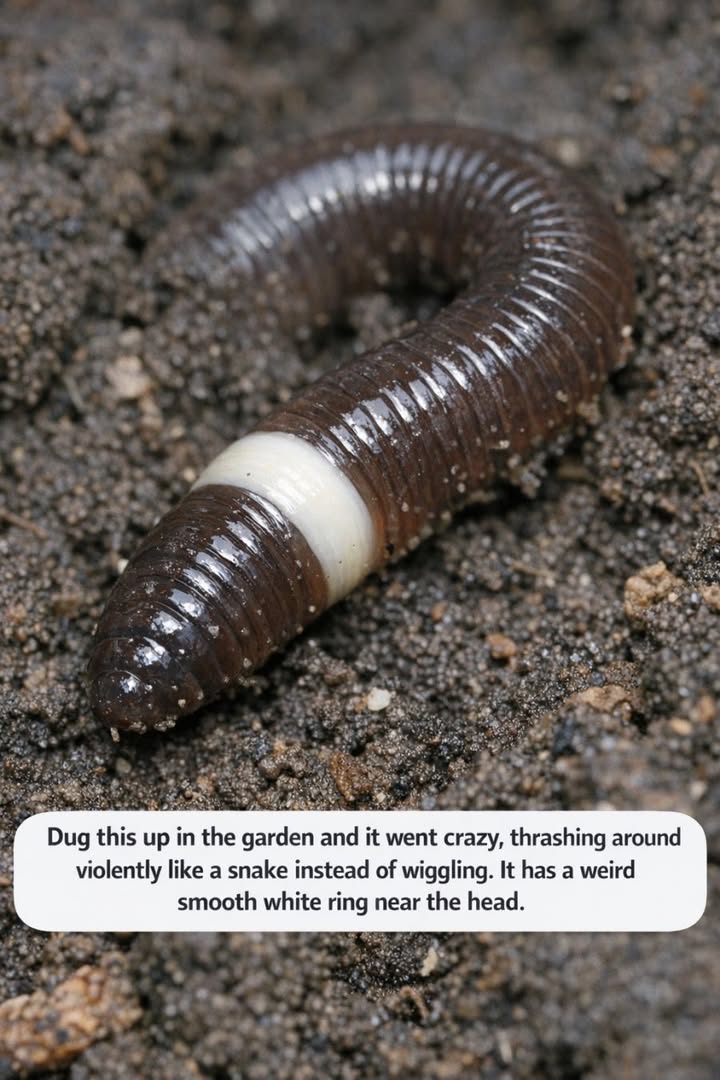
Dug this up in the garden and it went crazy, thrashing around violently like a snake instead of wiggling. It has a weird smooth white ring near the head.
Pages: 1 2
