
It’s not uncommon to see white spots or ridges on our nails. Even worse, at certain times, they can become brittle. But what does this say about our health? Is it a cause for concern? Let’s take a closer look.
Between repeated manicures, washing dishes, gardening, hot baths, and even minor injuries, our nails are put to the test. Like all parts of the body, they can undergo changes. As a result, they can change in appearance, break, split, and white spots can form. These spots are often a reflection of other minor health problems. An OPI manicure expert reveals everything they can tell us about our health.
White nails: why do I have white spots on my fingernails and toenails?
Do you notice small white spots on your nails? Don’t panic, these little marks are simply air bubbles. “It has nothing to do with calcium deficiency!” declares Alexandra Falba, OPI manicure expert. Let’s dispel the myths. “The nail is made up of dozens of layers of keratin that are compressed together,” she explains. “When you experience a micro-impact on the nail, the layers separate superficially.” This phenomenon is what creates the appearance of the white spot. These small spots should, of course, not be confused with leukonychia, which is a discoloration of the nail.
Micro-impacts can be caused by all sorts of everyday activities: housework, nail biting, typing on a computer keyboard, washing dishes… Even if it’s not painful, our nails can suffer. As surprising as it may seem, these white spots can develop on you
How do you remove them? There’s no cure: once the stain appears, you have to wait for the nail to grow back for it to disappear. But you can take preventative measures by slowing down and being careful with your movements. You can also “wear gloves during activities that could cause micro-impacts, to lessen the impact on the nail.” Keep this in mind when washing dishes or gardening. Finally, to “make the nail more flexible,” the professional advises applying a vegetable oil or balm daily, as a flexible and nourished nail better withstands impacts.
Horizontal ridges on nails: what do they mean? Ridges can have several causes. The first is genetic. If you’ve had vertical or horizontal lines on your nails since adolescence and your parents have the same thing, the cause may be hereditary.
The second cause is quite simply… aging. “The ridges on the nail are the equivalent of wrinkles on the face,” explains Alexandra Falba. “The older you get, the more likely you are to see these ridges appear.”
Finally, there are some whose appearance is “solely linked to excessive dryness of the nail.” When it’s dry, “the keratin layers struggle to align properly, which is why the ridges appear,” observes the expert.
Whatever the cause, there are solutions to reduce the appearance of these marks. First, apply an “emollient balm, a nourishing balm, or a vegetable oil daily to the surface of the nail, massaging it in to restore its suppleness and flexibility, thus reducing the appearance of the ridges.” This massage also nourishes the nail matrix (the area around the nail).
To smooth the surface of the nail, the professional suggests another solution: a filler base coat. “It dries clear and fills in the gaps between the ridges.” You can find it for around 8 euros at pharmacies; it can be applied instead of a regular base coat.
Using anything that can remove or abrade them, such as files or pumice blocks, is strongly discouraged, as it will weaken the nail even further. “It’s a quick fix, but it makes the nail soft and brittle,” warns Alexandra Falba.
Brittle nails: what’s the problem and what’s the cause?
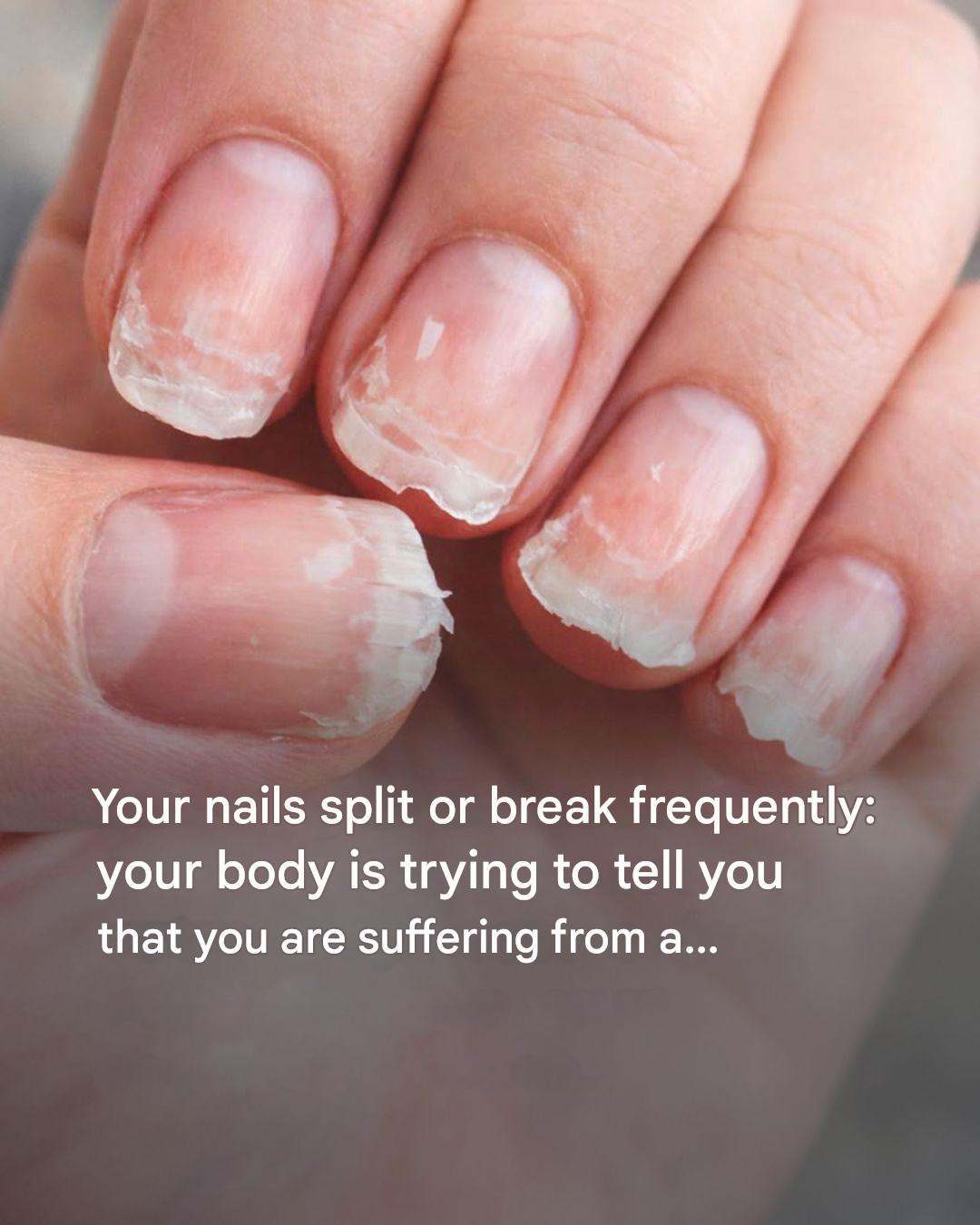
Splitting is often caused by “dryness combined with repeated minor impacts on the free edge, that is, on the tips of the nails,” which prevents proper nail growth. It can also be due to a poor diet, lacking in nutrients. Without these essential elements, the nail matrix will be of poor quality. However, if your diet is healthy and balanced, it will produce stronger nails.
Regarding brittle nails, Alexandra Falba is clear: “A brittle nail is always a dry nail.” This means you’re not nourishing it often enough with proper care.
The solution to these two problems? Take specialized nail-strengthening supplements or those rich in omega-3 fatty acids. It’s also advisable to “keep your nails shorter to limit the number of impacts they receive daily and to apply a nourishing balm or vegetable oil every night before bed,” explains the professional.
Nail color: Why are my nails yellow? Is it related to an illness?
Regarding yellowing: “It all depends on external factors,” notes the OPI expert. Smoking is one of the factors that causes nails to yellow. This phenomenon can also be explained by frequently forgetting to apply a base coat before applying colored nail polish.
How to keep nails white? “Don’t forget to apply a base coat before the polish; it’s essential.” Then, if they are already stained, you have two options. You can rub your nails in half a lemon every day until they lighten, or once or twice a week to maintain whiteness. Alternatively, make a thick paste of water and baking soda and scrub your fingertips with a soft brush. To see results, repeat this for at least four days.
For those of you who are more concerned, you can always consult a doctor for more information and, if necessary, treatment.
Thanks to Alexandra Falba, OPI manicure expert, for her advice.
